Before talking about markets, the first thing must be named: 335 people dead, 486,917 people registered as affected, 36,478 homes destroyed and 206,931 damaged, according to the UNGRD (national disaster risk management unit) report as of October 9 (El Tiempo, 2026). Nothing that follows weighs more than that. I write about the rubble because the health of those families, their rivers and the quality of the homes they will receive also depend on how it is managed.
A disclosure up front: Mano Verde provides consulting services in construction and demolition (C&D) waste management. I have an interest in this market existing. That is why I separate what is measured from what is my opinion, and at the end I say what would prove me wrong.
The size of the problem, and what we don't know
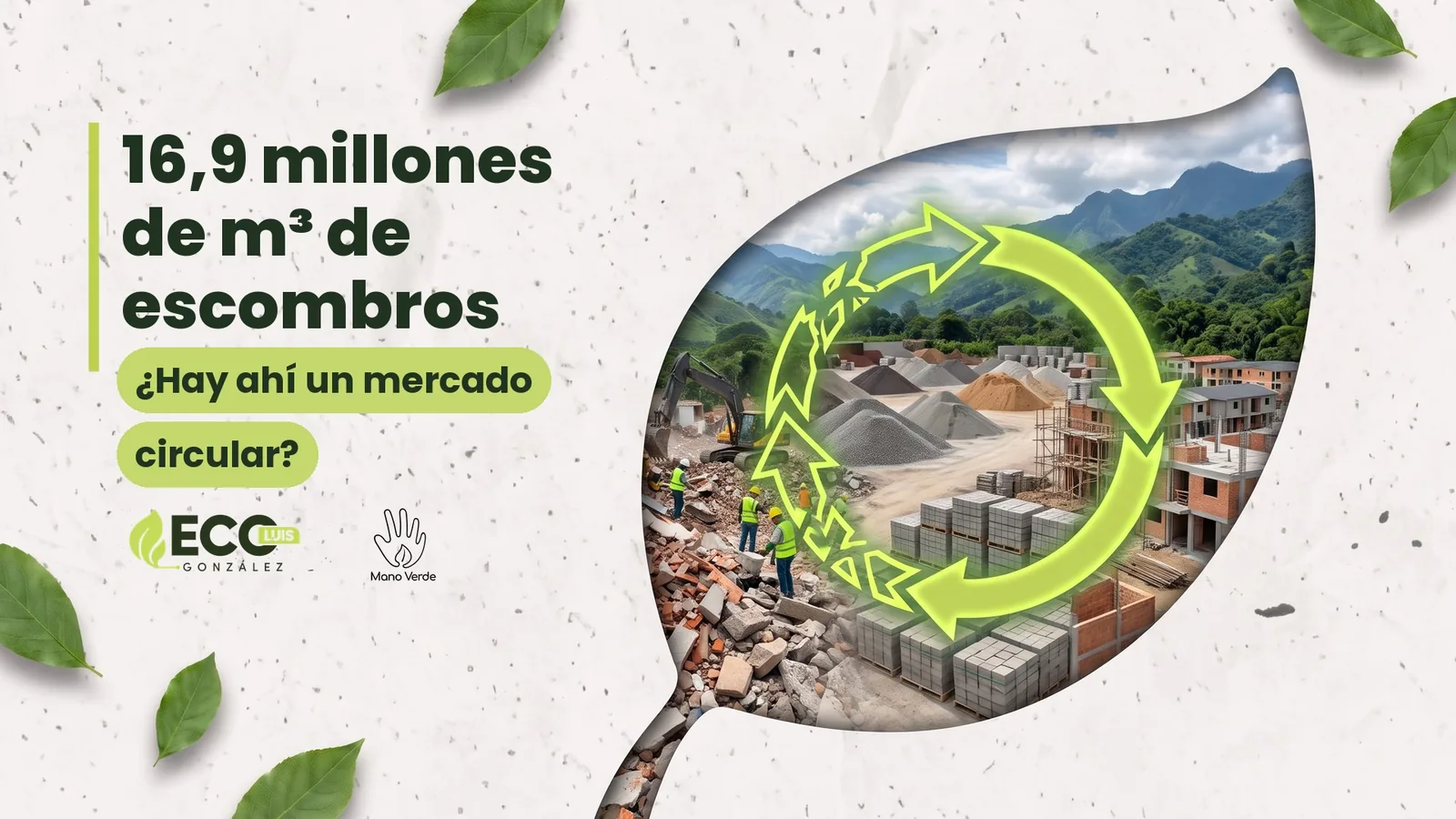
The RAPIDA assessment by UNDP and UNGRD estimated 16.9 million cubic meters of rubble, about 2.4 million truckloads. Risaralda accounts for more than 7.5 million and Valle del Cauca for more than 3.8 million (UNDP, 2026). It is a preliminary figure, calculated with models and not weighed on a scale.
To size it up, I do my own calculation, which is not official data: if each cubic meter weighed just one tonne, we would be talking about some 17 million tonnes. In 2019 the Ministry of Environment estimated about 7.4 million tonnes a year of construction waste and more than 22 million of demolition waste (cited in DNP, 2022). In other words, more than half the country's annual generation, concentrated in a few departments.
Here comes the first discomfort: that baseline is weak. The same DNP study warns that the country has no conclusive information on the properties of C&D waste or its production levels, and the figures published for Bogotá and Medellín vary by source. We are planning a market without reliable statistics on its raw material.
Installed capacity isn't comparable to the volume either. Reciclados Industriales de Colombia, with more than 15 years in operation, processed more than 148,000 tonnes in two years (La República, 2026). At that rate, a single plant would take more than 200 years to process the earthquake's rubble. It isn't a measure of national capacity, which I didn't find published, but it does show the distance between the two scales.
What is already being done well
It would be unfair to describe this as a void. By mid-October, Cali had received more than 232,000 tonnes, recording them by building of origin and classifying them as clean concrete, concrete with masonry and non-transformable mixed waste. It has a memorandum with GRECO (Argos, Ciudad Limpia and Daeyang) and the goal of using more than 140,000 pavers made with this material (El Nuevo Siglo, 2026).
In October, a joint circular from the ministries of Environment, Health and Housing and the UNGRD banned taking this rubble to rivers, wetlands, roads, vacant lots and landfills, required recording each trip with origin, destination and weight, and ordered materials containing asbestos to be handled as hazardous (MinAmbiente, 2026). That traceability is, without intending it, the database this market never had.
The parameters that temper the enthusiasm
- 1Health before recovery. In Hatay, after the 2023 Turkey earthquake, respirable dust measured during removal exceeded the national limit by about 6.2 times, and asbestos-like structures were observed, although not confirmed (Oral et al., 2025). In Colombia, asbestos installed before 2021 was not covered by the ban in Law 1968 of 2019, so it may still be present in the roofs of many affected homes. Crushing without sorting first isn't circular economy: it's a health risk with a green label.
- 2Contamination and mixing. Earthquake rubble isn't construction site waste. It arrives mixed, and what is poorly sorted ends up in the category nobody buys. The breaking point is the demolition, not the plant: what gets mixed there can't be recovered later.
- 3Technical quality. A study by Universidad Distrital found aggregates from Bogotá rubble dumps that don't meet the NTC 174 standard for concrete, although it doesn't rule out their non-structural use (Tecnura, 2017). Internationally the evidence is more favorable: a review of tests reports beams and columns with recycled aggregate performing comparably to or slightly below conventional ones, including under cyclic loading (Deresa et al., 2020). But tests on beam-column joints, a known weak point in earthquakes, remain few. In the area that just suffered a 7.4, I wouldn't recommend starting with structural uses.
- 4The environmental benefit isn't automatic. In a Portuguese case, recycled aggregate emitted about 5 kg CO2e per tonne compared with about 31 for natural aggregate (Dias et al., 2021). That advantage shrinks with distance and changes with the means of transport. Also, if the mix needs more cement to reach the same strength, part of the saving is lost, and cement is usually where concrete's footprint is concentrated. A review of 76 studies calls for a common framework because the results depend heavily on how avoided impacts are accounted for (Bayram and Greiff, 2023).
- 5Economics doesn't match the environment. In that same study, recycled aggregate remained environmentally better even when traveling up to 500 km more than natural aggregate, but it was only cheaper if it traveled 53 km less. A Colombian entrepreneur in the sector puts his own economic limit at 350 km (Entrepreneur, 2026), a figure best read as an interested party's estimate. There is a range where recycling is good for the planet but not for the wallet, and that range doesn't close on its own.
- 6Demand is weak and the rule pushes supply. Building construction was falling in the second quarter of 2026, while civil works grew 17.1% (DANE, cited in Entrepreneur, 2026). And Resolution 1257 of 2021 changed the basis of the target: it used to be measured against the materials used on site and is now measured against the C&D waste generated, with 50%, 30% or 20% from 2026 depending on the municipality's category, only for projects of 2,000 m² or more (MinAmbiente, 2023). It is a rule that forces material out, not one that makes anyone buy it back. Moreover, of the estimated COP 42.1 trillion in damage, COP 37.4 trillion is housing (UNDP, 2026), and much of that housing hardly fits the definition of a large generator.
- 7Territory. Chocó has high fragility and low scale; Risaralda has the largest volume. The earthquake damaged 521 roads (Infobae, 2026). A plant model designed for Bogotá or Medellín doesn't transfer to Quibdó. The regulation already allows mobile plants, and that is a clue.
- 8Temporary stockpiles can become permanent. In Nepal, two years after the 2015 earthquake, drivers and officials described dumping on riverbanks and ravines (Spotlight Nepal, 2017). And the specialized literature is less conclusive than it seems: it recommends recycling, but offers little guidance on how to choose between options after a disaster (Brown et al., 2011), a gap that a later review didn't see resolved (Zhang et al., 2019).
My position: the market isn't born from rubble, it's born from demand
After reviewing all this, I still believe there is a strongly emerging market. But I changed the argument. Having a lot of material doesn't create a market; it creates a disposal problem. What creates it is a recurring buyer who trusts the quality and has the material nearby. The reconstruction can be that buyer, if it gets organized in time:
- 1Repair before recycling. With 206,931 damaged homes, the most circular decision is not to demolish what can be safely reinforced. In two cases studied in New Zealand, retrofitting avoided between 83% and 93% of upfront carbon compared with an average new build (MBIE, 2024). They aren't Colombian cases or already damaged buildings, and no carbon saving justifies keeping an unsafe structure standing. That decision belongs to engineering.
- 2Anchor demand from public investment. Housing and works financed with reconstruction funds, such as the Fondo Milagro, should include recycled content where it is technically validated. First sub-bases, pavers, curbs and non-structural elements. Structural uses only when local tests exist.
- 3Contracts between builders and plants. Here is the linkage I propose: builders in the same region committing to buy volumes over several years, which lets an operator finance equipment and a laboratory. A single builder doesn't move this market; ten within a viable radius do.
- 4Quality verifiable by batch. A clear specification, tests with universities and laboratories in the region, and a data sheet per batch. Without that, the buyer's fear is rational.
- 5Circularity from the design stage. Audits before demolition, selective demolition and new buildings designed to be repaired and dismantled. If we only turn buildings into sub-base, we are downgrading material, not closing a loop.
- 6Plants where the material is. Mobile or regional, in the Pereira, Manizales, Armenia corridor and in northern Valle, with a different solution for Chocó, where perhaps the way forward isn't a plant but smaller-scale local recovery.
What would prove me wrong
I'll put the test in writing. In two years, my thesis doesn't hold if any of these things happen: recycled material remains more expensive than natural material within a reasonable radius; batches don't consistently pass quality tests; most of the traced rubble ends up in disposal rather than use; or the "temporary" stockpiles remain open with no closure plan. The weight records required by the circular would make it possible to check, if they are published. I ask that they be published.
Colombia already went through a major reconstruction after 1999, and I found almost no public data on how its rubble was managed back then. This time there must be a record, and the reconstruction can also leave behind a materials market. Are we, the builders of the region, willing to commit to purchases, and not just to meeting a delivery target?

Luis Hernando González González (Eco Luis) is an environmental consultant and founder of Mano Verde, a Manizales-based company recognized as a Green Business. www.manoverdeoficial.com Read and comment on the article on LinkedIn →
Is your organization burying its own raw materials?
We help construction companies, residential complexes, businesses and institutions in Colombia's Coffee Region design their waste system, train their people and measure results.
Sources (original titles in Spanish where applicable): UNDP and UNGRD, RAPIDA assessment (Aug 28, 2026). El Tiempo (Oct 10, 2026). Ministry of Environment, statement on the joint circular (Oct 22, 2026) and legal opinion 13002023E2004040 on resolutions 472 of 2017 and 1257 of 2021. Law 1968 of 2019. DNP and Logyca, Logística inversa de RCD en Colombia (2022). El Nuevo Siglo (Oct 16, 2026). Infobae (Sep 10, 2026). La República (Apr 17, 2026). Entrepreneur en Español (Oct 2, 2026). Oral et al., Int. J. Environ. Res. Public Health 22(4), 2025, doi:10.3390/ijerph22040649. Dias et al., Materials 14(18), 2021, doi:10.3390/ma14185452. Bayram and Greiff, Int. J. Life Cycle Assess., 2023, doi:10.1007/s11367-023-02145-1. Deresa et al., Advances in Structural Engineering, 2020, doi:10.1177/1369433220934564. Universidad Distrital, Tecnura, 2017. Brown, Milke and Seville, Waste Management, 2011. Zhang et al., Journal of Cleaner Production, 2019, doi:10.1016/j.jclepro.2019.06.229. Beca, Aurecon and Holmes for MBIE New Zealand (2024). Spotlight Nepal (Oct 27, 2017).