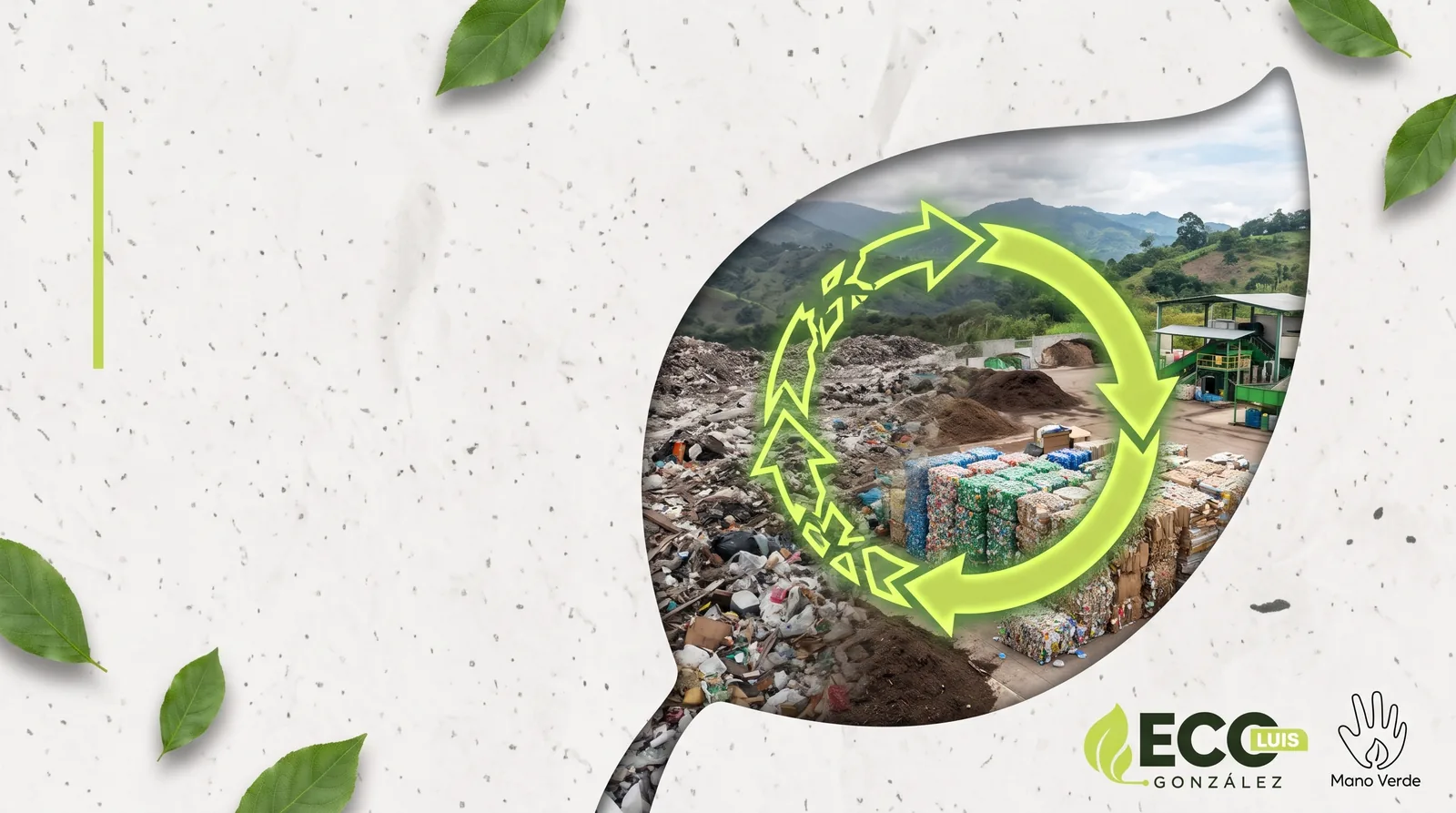
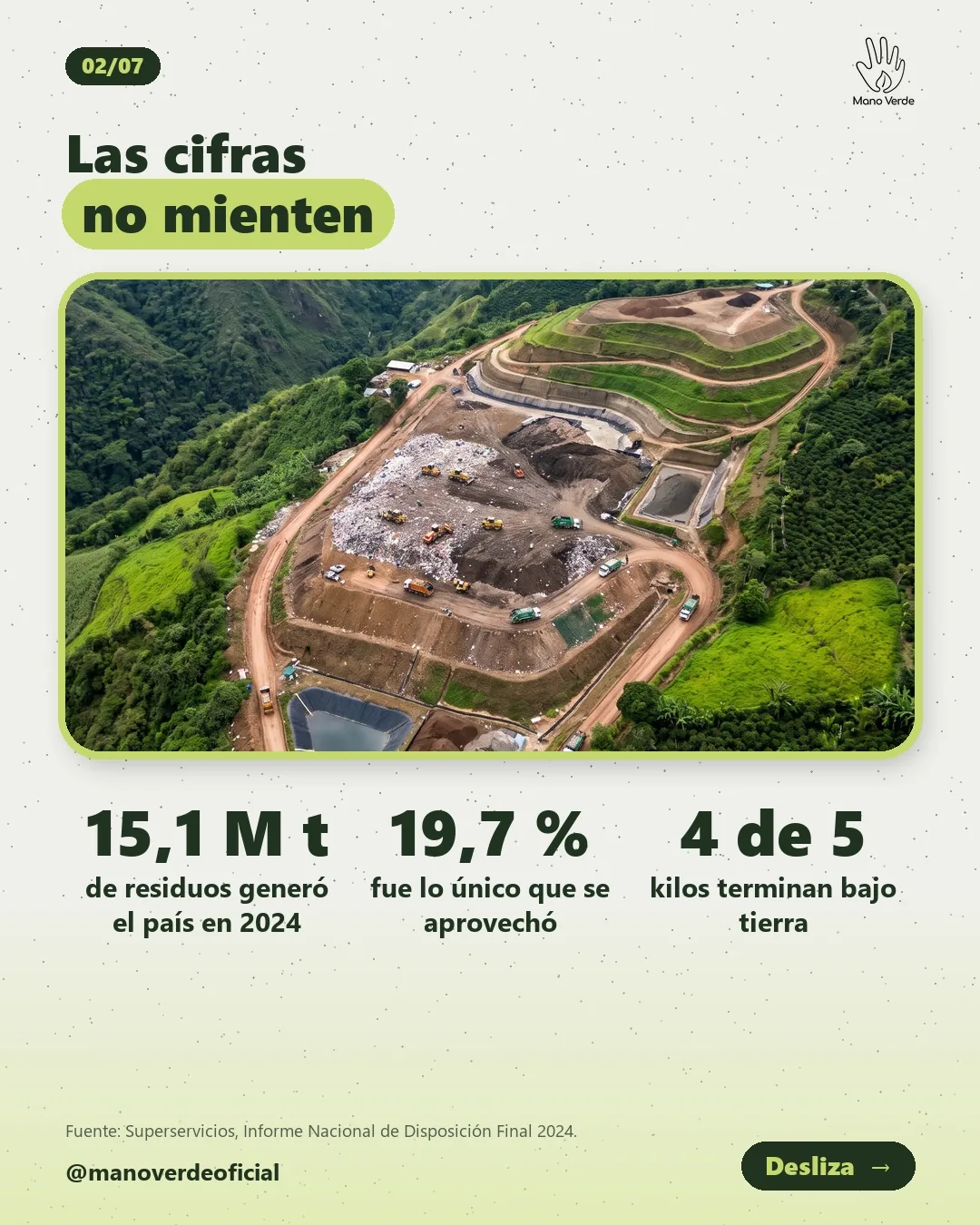
In 2018 Colombia became the first country in Latin America with a National Circular Economy Strategy. We celebrated the headline. Eight years later, the official figures tell another story: in 2024 the country generated 15.14 million tonnes of solid waste and buried 12.15 million, 25% more than in 2012. We recovered 19.7%. Four out of every five kilos still end up underground.
And the land is running out. Of the 249 registered final disposal sites, 45 have already exceeded their useful life and 31 have less than three years left. Eight departmental capitals (Bucaramanga, Cartagena, Cúcuta, Ibagué, Mitú, Quibdó, San José del Guaviare and Yopal) currently dispose of waste in expired landfills. Doña Juana, Bogotá's landfill, operates under a license extended until 2029 and in the first quarter of 2026 received 5% more waste than the previous year. The waste sector accounts for 9.4% of national greenhouse gas emissions, mostly methane.
What the State has done (and why it isn't enough)
It would be unfair to say nothing has been done. The National Circular Economy Strategy (ENEC) set out six material flows and five vehicles, including Extended Producer Responsibility. Decree 1381 of 2024 gave informal waste pickers 15 years of exclusivity over recovery. Decree 670 of 2025 regulated the Zero Waste program, with targets for 2026 and 2030 and a horizon to 2037. Resolution 555 of 2026 requires municipal waste plans (PGIRS) to analyze joint solutions. And the CRA (water and sanitation regulatory commission) resolutions 1039 and 1040 of 2026 finally created payment for treatment in the waste collection fee.
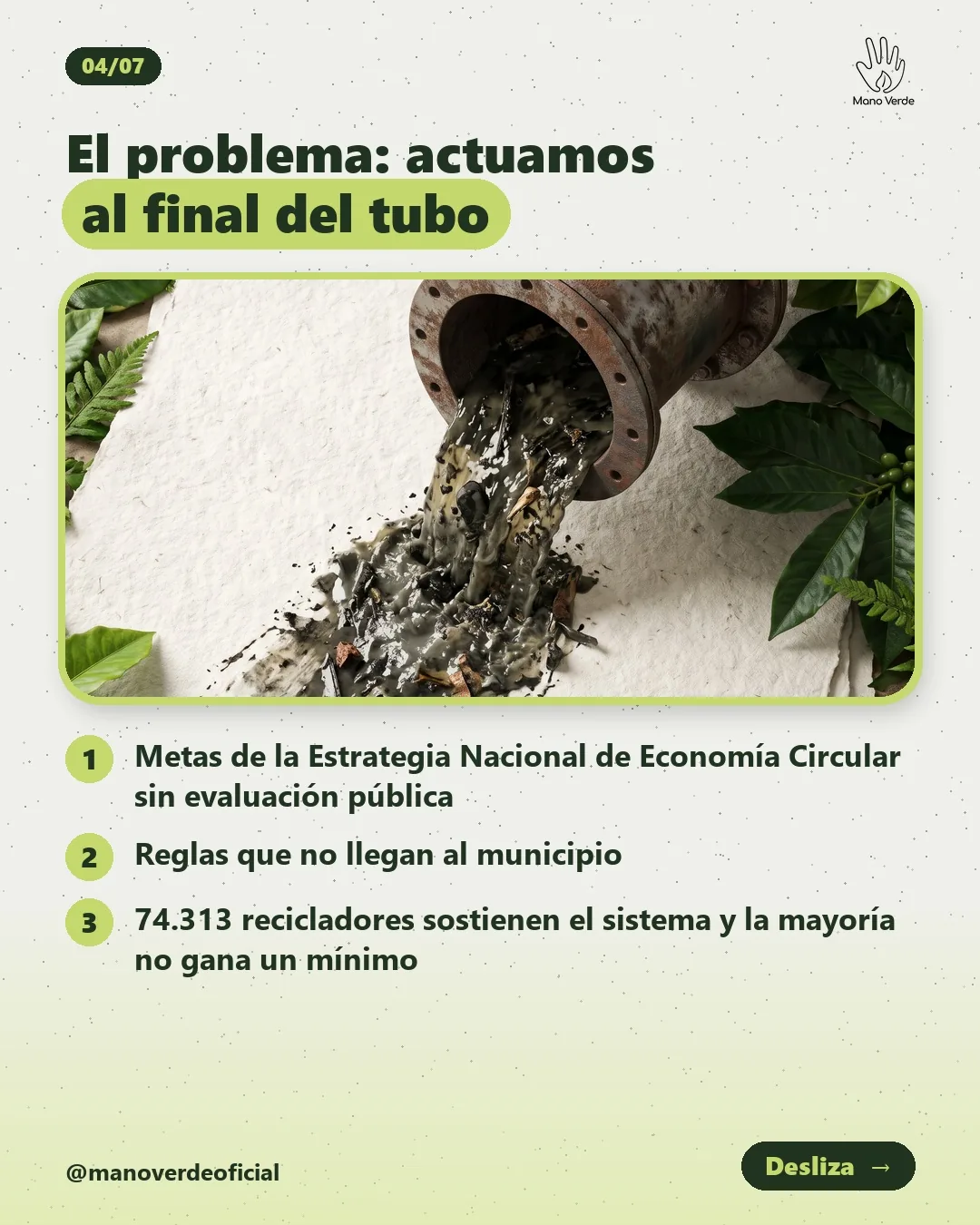
The problem is that all of this comes at the end of the pipe. Colombia's circular economy public policy is still, in practice, a recycling policy: it acts when the waste already exists. Three symptoms confirm it:
- 1Targets without public evaluation. The ENEC promised indicators to 2030 and up to 11.7 billion dollars a year in savings and new businesses. There is no public report saying how much of that was achieved. What we do know is that we bury more than twelve years ago.
- 2Rules that don't reach the municipality. The environmental regulation for co-processing waste in cement kilns has existed since 2008, but there is no national specification for refuse-derived fuel nor model contracts between city, service provider and plant. Payment for treatment exists on paper and is not yet applied. The gap, as Asocapitales (the association of capital cities) acknowledges, lies in the municipal chain.
- 3Those who sustain the system don't make a living from it. The 16% that Colombia recovers is carried by 74,313 informal waste pickers in 1,161 organizations. Most don't earn the minimum wage. An economy that depends on workers who don't reach the minimum wage isn't circular: it's extractive by another name.
Where it should go: the circular economy as an engine, not as landfill
The circular economy isn't a waste policy. It's an industrial policy. If we take it seriously, it should be organized like this:
- 1Start with design, not with the bin. As long as EPR is limited to a few waste streams and collection targets, producers have no incentive to design packaging and products that return to the cycle. EPR should cover packaging, textiles and construction with eco-design and recycled content targets, not just tonnes collected.
- 2Pay for recovered material, not for the buried kilo. The waste collection fee still rewards disposal. Applying the 2026 CRA resolutions now and putting recovery on the same footing as disposal is the most concrete decision the government can make this year.
- 3Make landfill the last resort, with data. Mandatory, verified source separation for large generators (industry, construction, residential complexes), digital traceability of every tonne and recovery of organics, which are more than half of what we bury.
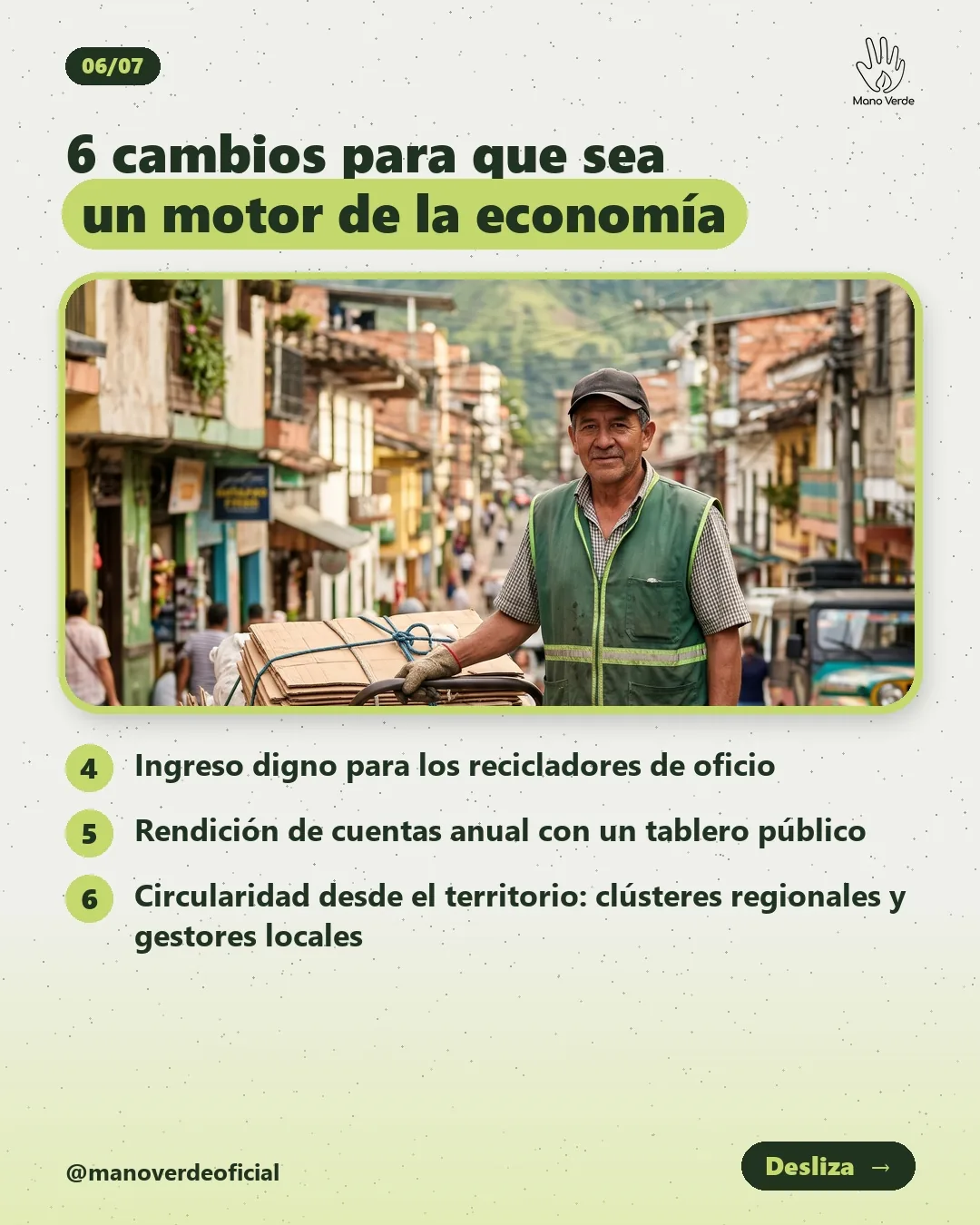
- 4Formalize with a decent income. Fifteen years of exclusivity for waste pickers is useless if the model doesn't guarantee them an income above the minimum wage and access to the highest-value materials.
- 5Measure and report every year. A public ENEC dashboard with the 2030 targets and real progress, by region and by material flow.
- 6Bring circularity to the regions. Capital cities account for 85% of national recovery, and nine capitals dispose of less than 100 tonnes a day. The circular economy of Caldas, Risaralda or Quindío won't be solved from Bogotá: it needs regional clusters, local operators and companies that see waste as an input.
What we see on the ground
At Mano Verde we support construction firms, residential complexes, companies and institutions in Colombia's Coffee Region with waste management, C&D waste and carbon footprint. What we find repeats itself: organizations that want to comply, waste rooms with no design, nobody measuring, and waste pickers doing the work the system doesn't pay for. When the system is designed, people are trained and results are measured, recovery goes up and the fee goes down. It isn't theory: it's what happens in every residential complex and on every construction site where it's done well.
The circular economy can be the engine of a regional economy that today buries its own raw materials. But that requires we stop measuring success in tonnes disposed of "correctly" and start measuring it in materials that come back, decent jobs created and landfills that stop growing.
The question for the government, for cities and for companies is the same: do we keep managing garbage, or do we start designing circularity?
Luis Hernando González González (Eco Luis) is an environmental consultant and founder of Mano Verde, a Manizales-based company recognized as a Green Business. www.manoverdeoficial.com Read and comment on the article on LinkedIn →
Is your organization burying its own raw materials?
We help construction companies, residential complexes, businesses and institutions in Colombia's Coffee Region design their waste system, train their people and measure results.
Sources (original titles in Spanish where applicable): El Tiempo (Oct 16-23, 2026), Semana (Climate Week Medellín 2026), Superservicios (Informe Nacional de Disposición Final 2024), La República (Feb 2025), Decree 670 of 2025, Resolution 555 of 2026 of the Ministry of Housing (MVCT), Ministry of Environment (ENEC) and Consejo Colombiano de Seguridad.