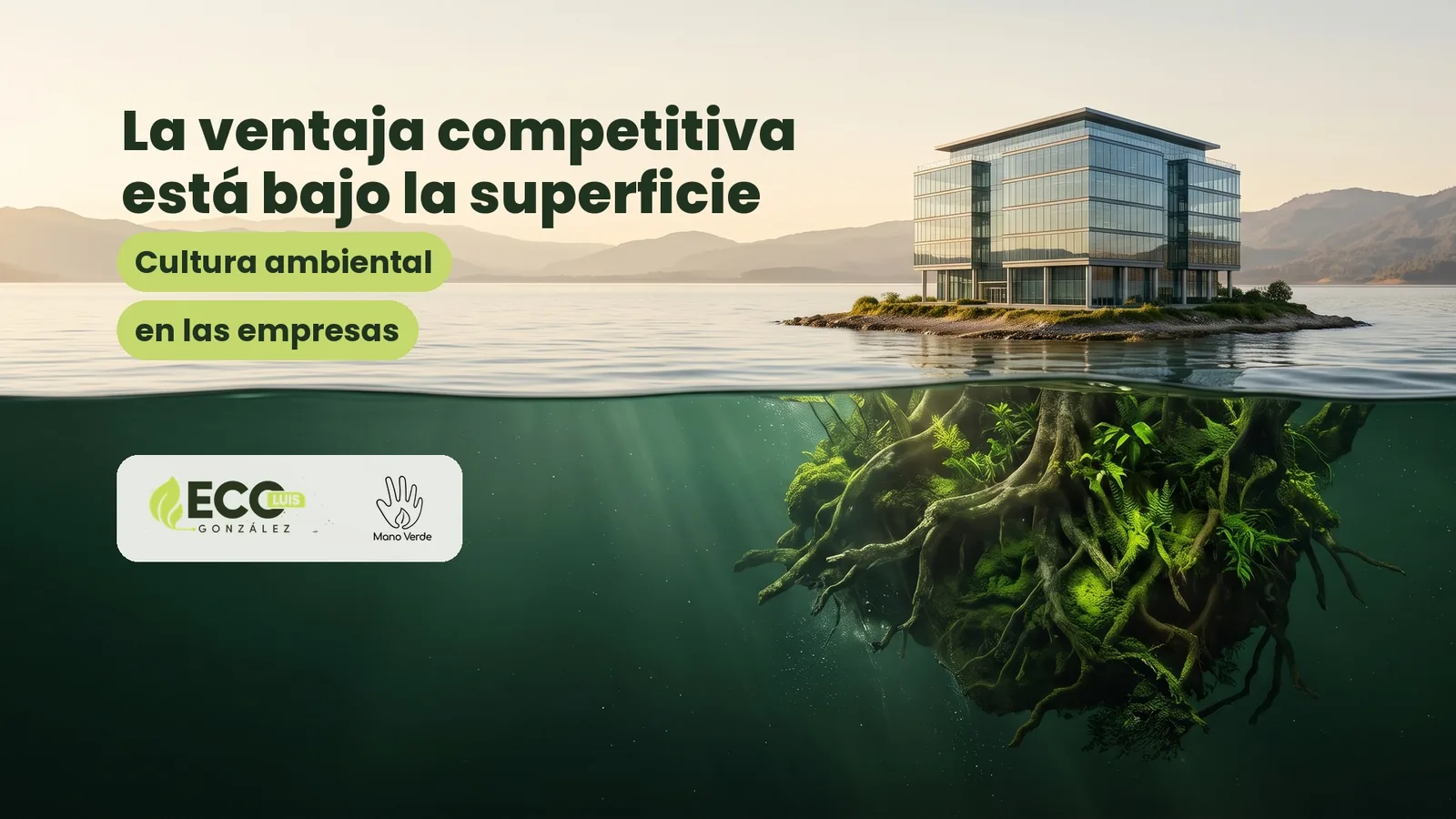
On the company visits we make, I almost always find the same thing: color-coded bins, a water-saving poster and, sometimes, a framed certificate at reception. When I ask who makes decisions about waste, how much is generated each month or what happens if an environmental target is missed, the conversation gets shorter. There are actions, but there is no culture.
A disclosure up front: Mano Verde is an environmental consultancy and a BIC company (Colombia's benefit corporation status). I have an interest in companies investing in environmental management, and being BIC does not, on its own, guarantee an environmental culture either. That is why I separate what is measured from what is my opinion, and at the end I say what would prove me wrong.
What the figures say
I'll start with what has been measured. None of these figures, taken alone, proves a lack of culture; together, they reveal a pattern.
- 1Actions, yes; strategy, no. In Anif's 2022-2023 survey, 76% of micro, small and medium-sized enterprises said they took at least one environmental action. In the 2025-2026 survey, only 26.8% have environmental initiatives backed by a documented strategy, more than 89% have no environmental certifications, and the main reason for acting is to cut costs (46%). They are different surveys and do not measure a trend, but the contrast speaks volumes: there are isolated practices, not a system.
- 2Investment follows pressure, not conviction. According to DANE's Industrial Environmental Survey, environmental investment by the manufacturing industry in 2024 was COP 794,478 million, 15.3% less than in 2023, and investment in waste fell by 55.1%. Two sectors, oil refining and food, account for two thirds of the total.
- 3More is paid to comply than to train. The same survey shows that industry paid COP 32,725 million in environmental licenses, fees and fines, about seven times what it invested in environmental training (COP 4,772 million). Carbon footprint measurement accounted for 0.26% of environmental spending, and on average about 1.2 people per facility work on environmental activities.
- 4Certifications are scarce. Colombia has 2,389 ISO 14001 certificates (ISO Survey 2024), the second highest number in Latin America, compared with more than 1.75 million companies registered in 2026. By my own count: even if each certificate belonged to a different company, it would cover less than 0.2% of the business community.
- 5Most of what is thrown away is still the majority. The national waste recovery rate in 2024 was 19.69% according to the Superintendency of Public Utilities (Superservicios), and 43.74% of what is disposed of goes to landfills with less than three years of remaining life.
- 6Rules without follow-up. Decree 1299 of 2008 requires medium and large industrial companies that need an environmental license or permit to have an environmental management department, whose duties include training. Eighteen years later there is no public compliance data. Law 2173 of 2021, on tree planting per employee, was regulated in 2025, and in 2026 the deadline to define the "Areas of Life" was extended: almost five years later it is still not enforceable.
Theoretical frameworks: how to read the problem
The figures tell us what is happening. To understand why, I rely on six frameworks from management, sociology and psychology.
- 1The three levels of culture (Schein). A culture has visible artifacts (bins, posters, certificates), espoused values (the environmental policy) and basic assumptions that nobody questions ("the environment is a cost", "that's a job for the health and safety team"). In Colombia we almost always work at the first level. As long as the assumptions don't change, the artifacts remain decoration.
- 2Institutional isomorphism (DiMaggio and Powell). Organizations resemble each other because they are forced to (coercive pressure), because they copy each other (mimetic pressure) or because that is what the professions teach (normative pressure). Many companies adopt environmental practices to appear legitimate, not to change. The literature calls this decoupling: the formal practice exists, but it doesn't touch operations.
- 3The intention-behavior gap (Ajzen; Kollmuss and Agyeman). People saying they care about the environment is not enough for them to act. Behavior also depends on the group's social norm and on how much control people feel they have. A yearly training session changes neither.
- 4The natural-resource-based view of the firm (Hart). Sustainable advantage comes from capabilities that are hard to copy: preventing pollution, managing the product across its entire life cycle, innovating. These capabilities are built through accumulated learning and with people who participate, in other words, with culture. You can buy a certification; you can't buy a capability.
- 5The Porter hypothesis and shared value (Porter and van der Linde; Porter and Kramer). Well-designed regulation can spur innovations that offset its cost, and social and environmental problems can become business opportunities. The key lies in the word "can": it only happens if the company has the capacity to learn.
- 6Stakeholder theory (Freeman). Customers, workers, communities, banks and authorities affect a company's value. When a large customer asks a supplier about its carbon footprint, the environment stops being a compliance issue and becomes a commercial one.
The logic of the failures: from paperwork to missing culture
If I arrange the figures with these frameworks, like a problem tree, the chain looks like this. It is my reading, not a measurement:
- 1Regulation arrives late or is not enforced, so environmental management is experienced as paperwork to avoid penalties (coercive pressure without follow-up).
- 2Because it is paperwork, it is assigned to one position, often shared with health and safety, and not to senior management. The environment doesn't enter purchasing, production or sales decisions.
- 3Because it isn't part of management, the budget is reactive: about seven times more is paid in licenses, fees and fines than is invested in training people.
- 4Without training or measurement (the carbon footprint is 0.26% of spending), nobody knows how much is generated or what it costs. What isn't measured isn't managed.
- 5Without data or participation, actions remain artifacts: recycling stations, campaigns and, at best, a certificate kept up for the audit.
- 6The result: actions without culture. The effects are investment that drops when pressure eases, landfills at capacity, ceremonial certifications and companies that can't answer when a customer asks.
One root cause runs through the whole chain: 94.8% of Colombian companies are micro-enterprises, with little technical and financial capacity. There, culture isn't built with corporate manuals, but with simple tools and hands-on support.
Why it's missing and why build it
Why is environmental culture missing? Because the system rewards appearing rather than being: regulation is barely enforced, certifications grant legitimacy without demanding deep change, and management sees the environment as a compliance cost.
Why build it? Not to have one more certificate, but so the company spends less on materials, water and energy; so its people propose improvements without waiting for an order; so it can answer customers, banks and international buyers with data; and so its operations hold up when the rules or prices change.
Competitive advantage: what the evidence says, and what it doesn't
It's easy to sell smoke here, so I'll tread carefully.
For: the review by Friede, Busch and Bassen (2015), covering some 2,200 studies, found that about 90% report a non-negative relationship between environmental, social and governance performance and financial performance, and most report a positive one. The meta-analysis by Dixon-Fowler and colleagues (2013) found a positive relationship, and that small companies benefit as much as or more than large ones. Endrikat and colleagues (2014) found that the effect is stronger when the environmental strategy is proactive rather than reactive. And Wang (2019), studying 327 manufacturing companies, showed that a green organizational culture predicts competitive advantage through green innovation.
Against, or with nuances: Hang and colleagues (2019), covering 142 studies, found no financial effect in the first year, only in the long term. Atz and colleagues (2023) conclude that the return from investing with environmental, social and governance criteria is, on average, indistinguishable from conventional investing. Lanoie and colleagues (2011) found no support for the strong version of the Porter hypothesis: regulation spurs innovation, but that innovation doesn't always offset the cost.
What matters most for this argument: Aravind and Christmann (2011) found that ISO 14001-certified facilities do not perform better environmentally than non-certified ones, except those that implement the standard well. Boiral (2007) documented how the standard becomes ceremonial when workers barely understand it. And Heras-Saizarbitoria and colleagues (2011) showed that the companies that get certified are those that already performed better, but they don't improve after doing so.
My conclusion is more modest than the usual rhetoric: environmental management doesn't guarantee immediate profitability. The advantage appears in the medium and long term, and it appears when management is proactive and embedded in the culture, not when it stops at the certificate.
We also need to be precise about market pressure. The European Union's Carbon Border Adjustment Mechanism (CBAM) has been in its definitive phase since January 2026, but it affects few Colombian sectors. And the 2026 Omnibus Directive raised the thresholds of the European reporting and due diligence rules, with a cap that protects small suppliers from excessive information requests. For most SMEs there will be no direct European obligation; the pressure will be commercial, through what their customers ask for. And that is better answered with culture than with paperwork.
How to build it: a logical framework roadmap
I propose a roadmap following the logical framework approach: activities that produce verifiable results, each with its own indicator.
- 1Diagnose assumptions, not just environmental aspects. Ask management, operators and buyers what they believe about the environment. Indicator: a culture diagnosis with a baseline, repeatable every year.
- 2Put the environment in senior management. Environmental targets in the KPIs of management and of the purchasing and production areas, not only in the environmental role. Indicator: percentage of management targets with an environmental component.
- 3Measure before you promise. A baseline for waste, water, energy and carbon footprint, with monthly data. Indicator: kilos, cubic meters and kilowatts per unit produced.
- 4Invest more in training than in fines. Practical, on-the-job training linked to real decisions. Indicator: the ratio between investment in training and payments for penalties.
- 5Make it routine. Sorting, measuring and proposing improvements as part of daily work, with recognition for teams. Indicator: improvements proposed and implemented by workers.
- 6Look at the value chain. Ask customers what they need and ask suppliers for the same. Indicator: customers receiving verifiable environmental information.
- 7Report honestly. Also publish what didn't work. A report that only lists achievements is, almost always, an artifact.
The expected impact, in two to three years, isn't a plaque at reception: it's a company that spends less, learns faster and can prove with data what it does.
What would prove me wrong
I would change my mind if studies with Colombian data showed that companies with isolated environmental practices, without strategy or employee participation, achieve the same savings, the same innovation and the same customer retention as those that build culture. Also if the next Industrial Environmental Survey showed that investment in training grows and total investment holds steady even when regulatory pressure eases. To date I have not found that evidence, and some key data, such as compliance with Decree 1299 or the current number of BIC companies that report, are simply not public.
The question for business leaders isn't whether they have a recycling station. It's whether, on the day nobody is watching, their people would keep doing the same.

Luis Hernando González González is the CEO of Mano Verde, a Manizales-based company that supports organizations in environmental management, the circular economy and regulatory compliance. Read and comment on the article on LinkedIn →
Is your organization burying its own raw materials?
We help construction companies, residential complexes, businesses and institutions in Colombia's Coffee Region design their waste system, train their people and measure results.
Sources (original titles in Spanish where applicable): DANE, Encuesta Ambiental Industrial 2024 (bulletin and annexes, February 2026); Anif, Gran Encuesta Pyme 2022-2023 and 2025-2026, cited by La República (August 4, 2026); ISO Survey 2024; MinCIT, business fabric report with RUES data (September 2026); Superservicios, Informe Nacional de Aprovechamiento 2024 and Informe de Disposición Final 2024; Decree 1299 of 2008 and Ruling C-486 of 2009; Law 2173 of 2021, Resolution 1491 of 2025 and Resolution 0358 of 2026 of the Ministry of Environment; European Commission, CBAM; Directive (EU) 2026/470 (Omnibus I); Schein (1990), American Psychologist, doi:10.1037/0003-066X.45.2.109; DiMaggio and Powell (1983), American Sociological Review, doi:10.2307/2095101; Ajzen (1991), doi:10.1016/0749-5978(91)90020-T; Kollmuss and Agyeman (2002), doi:10.1080/13504620220145401; Hart (1995), Academy of Management Review, doi:10.2307/258963; Porter and van der Linde (1995), doi:10.1257/jep.9.4.97; Porter and Kramer (2011), Harvard Business Review 89(1/2); Freeman (2010), doi:10.1017/CBO9781139192675; Friede, Busch and Bassen (2015), doi:10.1080/20430795.2015.1118917; Dixon-Fowler et al. (2013), doi:10.1007/s10551-012-1268-8; Endrikat et al. (2014), doi:10.1016/j.emj.2013.12.004; Wang (2019), doi:10.1108/JMTM-09-2018-0314; Hang et al. (2019), doi:10.1002/bse.2215; Atz et al. (2023), doi:10.1080/20430795.2022.2106934; Lanoie et al. (2011), doi:10.1111/j.1530-9134.2011.00301.x; Aravind and Christmann (2011), doi:10.5840/beq20112114; Boiral (2007), doi:10.1287/orsc.1060.0224; Heras-Saizarbitoria et al. (2011), doi:10.1016/j.jclepro.2010.09.002.